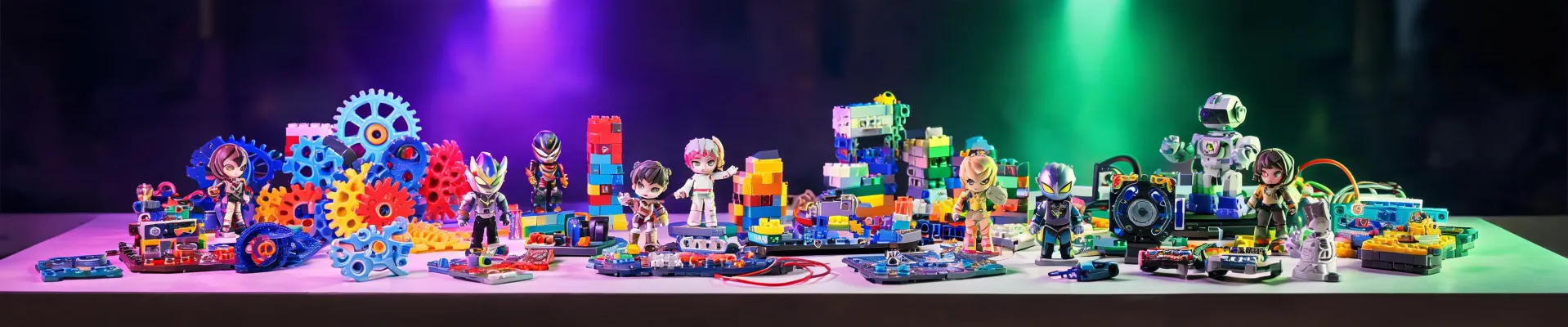
Wondering how to shop for Spin Master holiday toy releases? Start with your child's age, not the hype. New releases are exciting, but they don't automatically mean 'better.' The right starting point is the age band on the box, then play value against price, and finally, official confirmation on Spin Master's own site.
Start Your Holiday Toy Search with Age
Many parents approach the holiday toy hunt with a simple rule: buy the newest thing they've seen advertised. The logic feels natural—if it's new, it must be better, and if it's everywhere online, it must be what kids want. Retailers and influencer unboxings feed that impression, making it seem as though the latest launch is the only option worth considering. That instinct, however, pushes you straight past the two factors that actually decide whether a toy gets played with past December 26th. A heavily promoted robot might sit in its box because it's aimed at a tween who already moved on, while a quiet, time-tested building set sweeps through the family room for weeks. The mistake isn't caring about the holiday buzz; it's letting that buzz replace your own judgment about age fit and play value. The result is an underused toy, a disappointed child, and a budget that evaporates before the season even ends.
Here's the direct answer: lead with age, weigh play value next, and confirm release info only on the official domain. Age is non-negotiable because it governs safety and the type of play a child can actually manage. Spin Master, the Canadian toy maker behind many popular franchises, operates on a scale that makes its official communications the most reliable signal you have. The company employs over 1,600 people globally with offices spanning four continents, which means its product lines are deliberately built to cover every age band from toddlers to teens. That global presence also means the brand follows consistent safety protocols across markets, which is why the age label you see in one country matches the guidance in another. When a company that size organizes its catalog around age groups, you can trust that the age label on its packaging is the result of serious design and safety work. So ignore the hype, read the age band, and treat the brand's own website as your source of truth for what's really launching this holiday.
Match the Toy to the Age Band
Age bands exist for a reason: they align the toy's physical size, small parts, and complexity with a child's developmental stage. Spin Master's worldwide footprint shows how seriously the company takes that alignment. With 1,600+ employees and offices across Australia, Canada, China, France, Germany, Hong Kong, Italy, Japan, Mexico, the Netherlands, Poland, Slovakia, Sweden, the United Kingdom, the United States, and Vietnam, the company has the R&D and market research muscle to design age-specific lines rather than one-size-fits-all gadgets. That global scale also means the brand tests play patterns across cultures, so the age bands reflect real-world use, not just lab conditions. That means when you see a recommended age range on a Spin Master box, it isn't a suggestion—it's a safety-backed guideline informed by testing and regional standards. For a parent, the practical step is simple: locate the age label on the product page or packaging, and if the child falls at either edge of the range, note whether the toy offers adjustable complexity that can grow with them.
To put that into practice, start with the product page or the box itself. Spin Master lists a recommended age range, usually printed near the barcode or under the 'details' section on its official site. Write down your child's current age and level of fine-motor skills, then compare. For example, a set marked for ages 4+ might have small magnets that a three-year-old could choke on, so stick to the line. If the box says '6+', don't buy it for a five-year-old just because they're advanced for their age. The range is the floor for safety and the ceiling for frustration—many kids can play up, but the lower bound exists for a reason. For slightly older children, you can also read parent reviews that mention whether the toy held up over months. When in doubt, pick the next age tier down, because a toy that's too simple is easier to repurpose than one that's too dangerous.
Compare Play Value vs. Price
Once you have an age-filtered shortlist, compare your options on two axes: play value and price. Think of it as a simple grid with four quadrants. On one side are new releases—fresh, exciting, but often unproven. On the other side are classics that have been on shelves for a season or more, with reviews piling up from other parents. The vertical axis tracks price: a new premium toy might cost $80, while a classic version of a similar playset sits at $50. To read the grid, place each candidate in a quadrant and ask which purchase gives the most reusability for the money. The grid isn't about good versus bad; it's about trade-offs, and it forces you to name what you're giving up when you choose a shiny new launch.
The key difference between new releases and proven classics isn't quality—it's predictability. A new toy might become the season's must-have, but you're paying for the unknown: will the mechanism hold up, will the app updates keep coming, will it hold a child's attention after the novelty wears off? A classic, by contrast, has a track record. Other parents have already stress-tested it, and its play patterns are documented. If a classic is still popular a year later, that's evidence of durable play value. For a holiday buy, predictability matters even more, because a gift that fizzles by New Year's is a wasted slot under the tree. On the price side, new releases often carry a holiday premium, while classics get discounted or bundled with extras. Neither is automatically 'better'—the right choice depends on whether you value novelty or reliability, and how much budget you're willing to risk.
Picture this: your eight-year-old has asked for a new Spin Master speed drone. You see two options—a brand-new model with a sleek app and a $99 price tag, and last year's drone that now costs $59 and has four hundred five-star reviews. On the grid, the new one sits in the 'high price \/ unknown play value' quadrant; the classic sits in 'lower price \/ proven play value.' Your child wants the new one because a YouTube ad showed it doing tricks. You can explain that the classic does the same basic tricks, has a longer battery life, and leaves $40 for a second gift. By applying the grid, you make the trade-off visible and let your child participate in the decision.
Verify Releases on the Official Domain
Now that you have a shortlist, where do you confirm whether a product is actually releasing this holiday? The only reliable answer is the official Spin Master website. The company's global operation—with 1,600+ employees and offices on multiple continents—means its corporate website, press releases, and regional pages are managed by people whose job is accuracy. That standardization is what makes the official domain a reliable map: the same product appears with the same details across every regional site. A multinational toy company that size coordinates its product announcements through official channels; when you see a list of holiday releases on spinmaster.com, it has gone through legal, marketing, and supply-chain review. That's the difference between a trustworthy source and a rumor scraped from a forum. Third-party toy blogs can misread a catalog, and social media posts often jump the gun with unconfirmed street dates. Even if you see a leaked photo on a fan page, wait for the official confirmation before telling your child it's happening. If it's not on the official domain, treat it as speculation.
To make this a habit, bookmark the Spin Master website, subscribe to its email newsletter, and follow its official social accounts. On the site, navigate to the 'New' or 'Holiday' section to see what's actually shipping this season. If you spot a toy on a store shelf that isn't listed there, it could be a regional exclusive or an early surprise—but check the product's age label and packaging details directly. If the site lists a product code but the store shows a different one, the mismatch is a red flag. When you receive the toy, keep the box's official product name in hand, because that's what you'll use to search for recall notices or safety updates later. And because the company operates globally, official customer service can help you verify a model number before you buy. In short: let the official domain be your map, and treat everything else as a lead to verify.
Set a Budget and a Timeline
Set your holiday toy budget before you walk into a store or open a shopping app. A practical rule is to cap per-child spending at $100 to $150, depending on your comfort level, and limit the total number of gifts to two or three substantial items plus small stocking stuffers. This doesn't mean you can't buy a high-priced holy grail toy—it means you plan for it. If a must-have drone costs $120, allocate that as the one big gift and choose a less expensive second item. Write the number down and treat it as a fixed line; when you feel the pull of a $200 robot, you've already made the decision. That pre-commitment works because it turns an emotional aisle decision into a mechanical check.
Timing matters because holiday stock sells out and shipping gets slower as December approaches. In North America, order no later than the first week of December for standard delivery, and by mid-November for personalized or hard-to-find items. If you're buying from the official Spin Master site, check its shipping cutoff page—it usually lists a 'last order date for Christmas delivery' in November. For in-store pickup, you can wait longer, but popular new releases often vanish from shelves by the second weekend of December. Also consider that international shipping can add an extra week, so if you're outside the U.S., back your order date up even further. Build a simple calendar: research in October, decide your shortlist by early November, and complete purchases by Thanksgiving weekend if possible.
A wishlist is your brake pedal. Have your child list their top three Spin Master wants, then use that list to filter what you actually buy. When a marketing email shows you a 'limited edition' your child never mentioned, the list reminds you to stay on plan. For older kids, let them rank the list by 'what I'd play with for a year' versus 'what I want because it's new.' You'll often find the number-one pick isn't the most expensive—it's the one that connects with a hobby or a social group. Keep the list visible through the season, and update it if interest shifts, so the final purchase matches a real desire, not a momentary ad impression. It also prevents impulse buys from stealing the spotlight from the one gift your child truly wants.
Apply the Three-Check Rule
Before any purchase, run the three-check rule. Check one: does the toy fit the child's age band? Look for the manufacturer's recommended age on the box or product page, and respect the lower bound as a hard limit. Why? Because a toy that's too advanced is a safety risk, and one that's too basic will be abandoned within a week. Check two: does the play value justify the price? Compare the toy to its alternatives using the grid discussed earlier—if it's a high-price new release, demand a unique feature that a classic doesn't offer, like a building system that connects with other sets or a game mode that stays fun after the first month. Check three: is the release confirmed on the official domain? If the product isn't listed on spinmaster.com or an official retailer's product page with the correct age label, it's not confirmed yet; even credible-looking 'leaks' from fan pages don't count until the company itself announces a shipping window. Passing all three checks means you've made a decision you can stand behind, and you've also taught yourself a filter that will work for every future toy purchase.
On Christmas morning, your child unwraps a toy that you chose using those three checks. It's a building set that matches their age, offers hours of hidden reconfiguration, and you'd verified it on the official site weeks earlier. The box might not be the most viral unboxing on social media, but it's the one that gets played with while the rest of the room's gifts sit half forgotten. That's the quiet argument for shopping by age and play value instead of hype. No last-minute panic, no returns desk visit—just a gift that fits. When a neighbor asks how you skipped the line on this year's must-have, you can point to the age band, the play-test math, and the official release page—and let the toy speak for itself.
Age, play value, official confirmation: that trio separates a one-week fad from a favorite.

Miriam Adler
Miriam Adler is an educational and STEM toy analyst specializing in busy boards, Montessori-style manipulatives, learning towers, sound books, reading pens, pretend-play sets, and early learning toys. She applies ASTM F963 and IEC 62115 methods while evaluating small-part hazards, accessible edges, switch durability, sound output, battery access, pull force, and age-appropriate task complexity. Her work helps parents, retailers, and product teams choose learning products that align developmental goals, supervision needs, interaction design, and the intended age stage.